Cracow











 Gift a Cleaning
 Account




 Upholstery cleaning

 Offices, warehouses, industrial halls
 Window cleaning
 Handyman, small repairs
 Moving
 Other / Miscellaneous
 Cleaning
Window cleaning
Upholstery cleaning
Handyman
Moving
Cleaning
Window cleaning
Upholstery cleaning
Handyman
Moving
 Post-renovation cleaning
Upholstery cleaning
Offices, warehouses, industrial halls
Window cleaning
Handyman, small repairs
Moving
Other / Miscellaneous
Gift a Cleaning
Post-renovation cleaning
Upholstery cleaning
Offices, warehouses, industrial halls
Window cleaning
Handyman, small repairs
Moving
Other / Miscellaneous
Gift a Cleaning
 Start earning with CleanWhale
 Our products are hypoallergenic, after cleaning we completely wash them off from all surfaces. Upholstery cleaning is safe for children and pets
 Dry cleaning of a two-seater sofa
 Dry cleaning of a three-seater sofa
 Dry cleaning of corner sofa (4 persons)
 Dry cleaning of a corner sofa ( 5-6 people. )
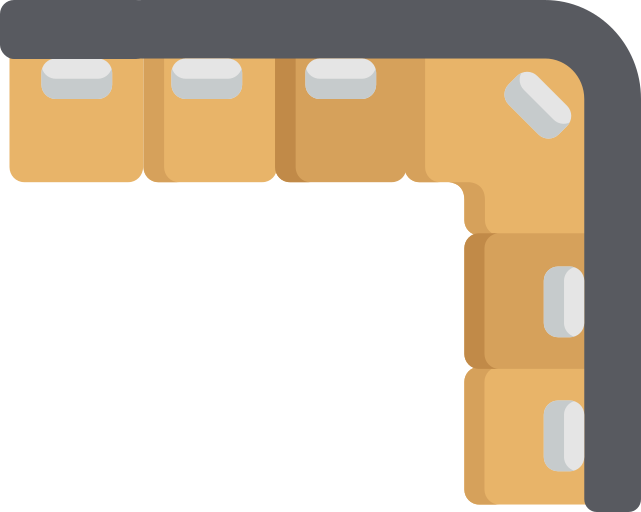 Corner sofa dry cleaning ( 7+ pers )
 Single mattress dry cleaning
Dry cleaning single mattress from both sides
Single mattress dry cleaning
Dry cleaning single mattress from both sides
 Dry cleaning double mattress
 on both sides
Dry cleaning double mattress
Dry cleaning double mattress on both sides
 Carpet cleaning
 Fitted carpet cleaning
 Dry cleaning chair
 Dry cleaning of chairs, stools
 Dry cleaning office chair
 Dry cleaning upholstered headboard to bed
 Baby stroller cleaning



 Oven Cleaning
 Cooker Hood Cleaning
 Kitchen Cabinet Cleaning
 Dishwashing Service
 Refrigerator Cleaning
 Microwave Cleaning
 Balcony Cleaning
 Window cleaning
 Ironing
 Litter Box Cleaning
 Extra hours
 Wardrobe Organizing and Cleaning


 Promocode is valid for orders from %from% until %to%
The calendar shows this cleaner's available dates. Want another day? Pick a different cleaner or choose Any.
Promocode is valid for orders from %from% until %to%
The calendar shows this cleaner's available dates. Want another day? Pick a different cleaner or choose Any.



 Google account connected
 Facebook account connected
 Logout
CleanWhale operates as an intermediary platform (marketplace) that connects you with independent Contractors providing cleaning and other services.
CleanWhale issues you a VAT invoice only for the Order Handling Fee — our remuneration for intermediary services: selecting and verifying the Contractor, coordination, and handling documents and payments.
The service is provided and documented directly by the Contractor, who issues you a separate document for its full value: a VAT invoice if the Contractor is an active VAT payer (VAT deductible on your side), or an invoice without VAT or a bill if the Contractor is exempt (a tax-deductible cost, without VAT deduction).
You therefore receive two documents per order, and both are tax-deductible costs. Your final price and payment method stay the same.
How we calculate VAT
CleanWhale charges VAT only on its own remuneration, not on the value of the service — the seller of the service is the Contractor, not CleanWhale. Our invoice: the Order Handling Fee plus 23% VAT, fully deductible on your side. The Contractor's invoice: VAT depends solely on their status. There is no double taxation — VAT appears at most once on each side.

Failed to write off money from the card. Perhaps there are not enough funds on it or the bank declined the payment
Change your payment method to cash or specify a different card


 Cash
Cash
 Card online/Apple Pay/Google Pay
 Bank transfer
 BLIK
BLIK
 Klarna
 Revolut Pay


 Our products are hypoallergenic, after cleaning we completely wash them off from all surfaces. Upholstery cleaning is safe for children and pets


A car interior gets dirty differently from a home. Crumbs, drinks, dust from the vents and damp off shoes all build up in a small space — and in a sealed cabin any smell is noticeable immediately. We clean car upholstery by hot water extraction, the same method we use on furniture.
It is the most delicate part of the interior. The fabric is glued to foam, and too much water dissolves the adhesive, causing it to sag and ripple — damage that is effectively irreversible without replacing the whole headlining. So we clean it with minimal moisture, by surface method rather than extraction.
Leather upholstery is not extraction-cleaned. It needs a dedicated product and conditioning, otherwise it dries out and cracks. If the car has leather or synthetic leather, mention it when booking, as it changes both scope and time.
The interior stays damp for a few hours afterwards. The car should sit with the windows slightly open in a ventilated spot. Shutting a wet cabin overnight ends in a musty smell — which is why this is best booked for the morning.
Quoted after looking at the car: it depends on the size of the interior, the scope and how dirty it is. We give the price before starting.
Usually a few hours for the full scope. Seats alone are noticeably quicker than a whole interior including headlining and boot.
Once it is dry, usually after a few hours of ventilation. Driving with a wet interior and the windows shut encourages a damp smell.
Cleaning the upholstery reduces it markedly. Where the smell has soaked into the headlining and ventilation, only follow-up ozone treatment tends to finish the job.
Yes, but by a different process — cleaning and conditioning rather than extraction.
Yes. Hair woven into the fabric is lifted mechanically first, as extraction alone will not pull it out.


 Send again